End-to-End Quality Control, From Source to After-Sales
Backed by a database of 2000+ qualified suppliers, 37 on-site audit criteria and 21 knockout red-line rules, we provide every client with end-to-end quality control services — from supplier matching and factory auditing to after-sales issue resolution.
One Partner for the Whole Chain
We do not sell isolated services. We run a single end-to-end chain — supplier screening, price negotiation, quality control and final delivery — so that global sourcing becomes efficient, predictable and defensible.
Acting as your extended procurement team overseas, we turn a specification on paper into a supply base you can rely on: suppliers that have been audited, batches that have been tested, compliance that has been documented, and deliveries that hold their date.
Lower Cost
No. 25-26, Lihu Business Park, 2008 Lihu Avenue, Binhu District, Wuxi, Jiangsu, China
Higher Efficiency
Procurement steps are simplified and chain nodes optimised, so your team stays on its core business rather than on expediting.
Assured Quality
Supplier admission criteria and multi-stage inspection hold every link of the chain to your agreed standard.
Reduced Risk
Compliance review and risk foresight cover trade barriers, currency movement and supply interruption before they land
Global Network
Supplier resources across the world’s main trading regions, matched to your product, your volume and your timeline.
Qualified Suppliers
Supplier Admission Steps
Knockout Red Lines
Response Time
General Issue Closure
Seven Steps from Candidate to Qualified Supplier
Sourcing is finding the right candidates. Supplier development is turning candidates into partners who can carry orders reliably. Every step below has an exit criterion — a supplier that fails any one of them does not reach your order book.
Requirement Briefing
An enquiry becomes a standardised sourcing brief across four dimensions.
Sourcing Channels
Online first: B2B platforms for rapid shortlisting, then company-registry and customs data to strip out intermediaries and confirm genuine export capability. Offline next: industry exhibitions and production clusters, where suppliers are verified face to face and benchmarked through association networks. Referrals from peers, forwarders and testing bodies form a third, market-tested channel.
Paper Screening
Sample Evaluation
On-site Audit
Paper compliance is confirmed at the plant. We audit production capability, the quality control system, and warehouse and compliance practice — what each covers is set out in the section below.
Trial Order
Before volume is committed, a small trial order tests actual delivery performance: locked specification, packaging and test requirements; in-process patrol and a pre-shipment final inspection; re-inspection on arrival against the COA; and an assessment of lead-time accuracy, packaging integrity, responsiveness and exception handling. A trial that passes moves the supplier into the qualified list.
Ongoing Management
Qualified suppliers are filed and graded — A (primary), B (capacity backup), C (contingency) — then reviewed quarterly and re-audited annually, with an immediate special review triggered by any serious incident or customer complaint. Suppliers that persistently miss target are downgraded or suspended.
What We Verify at the Factory
An audit is not a courtesy visit. It is the only reliable way to confirm that a supplier’s licence, capacity and quality system are genuinely its own.
Production Capability
- Line count, equipment condition and maintenance records
- Current utilisation and peak-season ceiling
- Whether any process is outsourced
- Experience and stability of the core technical team
- How scheduling, quality control and emergency response are actually managed
Quality Control System
- Incoming (IQC), in-process (IPQC) and final (FQC) inspection in operation
- Laboratory instrument capability and operator qualifications
- Record discipline and batch-level traceability from raw material to finished goods
- Non-conforming product handling and CAPA in practice
Production Capability
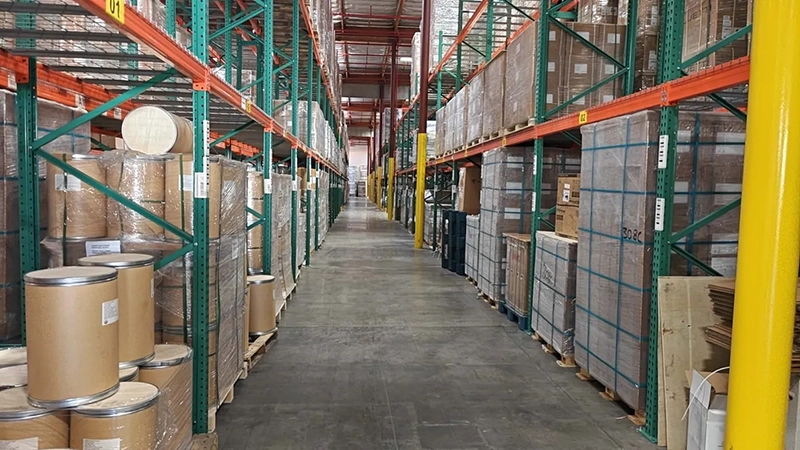
- Segregated storage with humidity, temperature and light control
- Batch management and FIFO discipline against mixed batches
- Clear status, batch and expiry labelling
- Environmental permits, waste handling, fire safety and certified operators
- Willingness to accept third-party customer audits; export declaration and certificate-of-origin capability
Four Control Gates, One Closed Loop
Control is applied before production starts, during production, before shipment and after any failure — so a defect is caught as early as possible and cannot recur.
Pre-Production · IQC
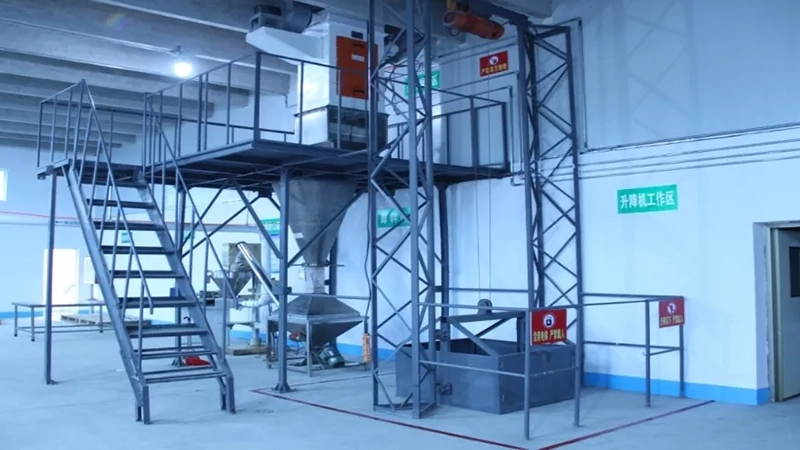
Incoming materials are inspected against your standard, international AQL and drawing requirements; non-conforming material is segregated and returned. A pre-production meeting aligns production, QC and procurement on the BOM, acceptance criteria, risks and contingency plan.
In-Process · IPQC
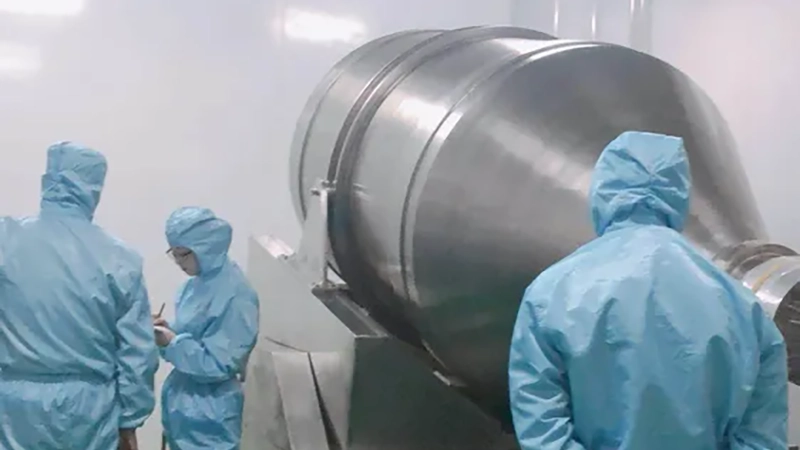
Patrol inspection at key processes, plus first-article approval. Production reference samples are held so that bulk output stays consistent with the approved standard rather than drifting with each run.
Pre-Shipment · FQC / OQC
Final inspection before dispatch — 100% inspection or sampling at your specified AQL level, covering appearance and workmanship, functional performance, packaging integrity and labelling compliance. Shipping documents such as the COA and inspection certificates are verified against the goods.
Exception Handling & Improvement · CAPA
Non-conformance handling with root-cause analysis and documented corrective and preventive action; complaint intake and investigation; replacement and liability determination; and supplier evaluation and delisting where the same defect recurs.
AQL — Acceptance Quality Limit.
Where sampling applies we follow the level you specify and a documented sampling plan. The batch is judged on the data, not on opinion.
Data, Collaboration, Early Warning
Qualifying a supplier and running a chain are different jobs. This is the daily management of flow, information and exposure.
Data-Driven Decisions
Demand, stock position, supplier delivery and logistics performance are monitored continuously, so replenishment and inventory allocation are decided on evidence rather than on habit.
Collaborative Platform
Order, logistics and inventory status are shared across the upstream and downstream nodes of the chain, removing the information lag that produces expediting, air freight and lost sales.
Risk Warning & Control
Supply interruption, logistics delay and market movement are monitored as standing risks, with contingency plans prepared in advance for the materials and routes that matter most.
Continuous Optimisation
The chain is reviewed on a fixed cycle. Bottlenecks and cost drivers are identified, then addressed through process change and system upgrade rather than left to next year.
The Chain at Work
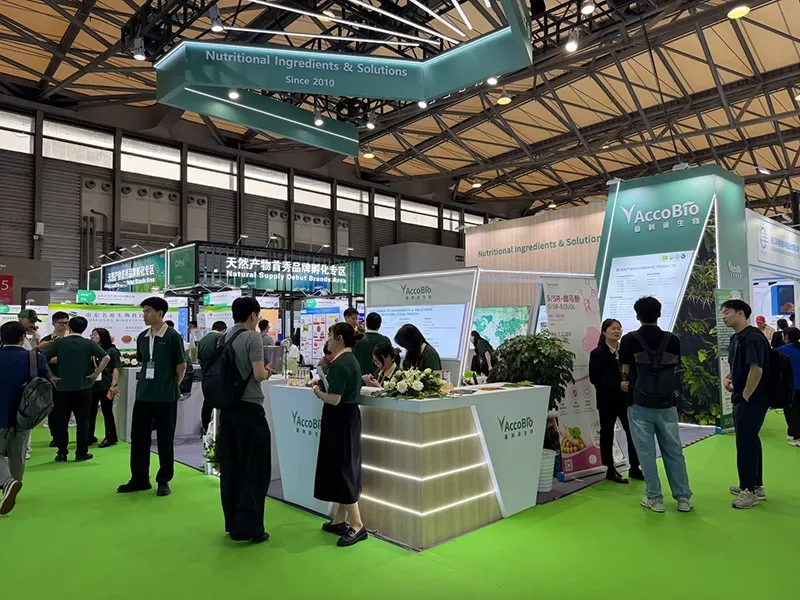
Sourcing at industry exhibitions
AccoBio at an international nutritional ingredients exhibition — supplier shortlisting and face-to-face verification.
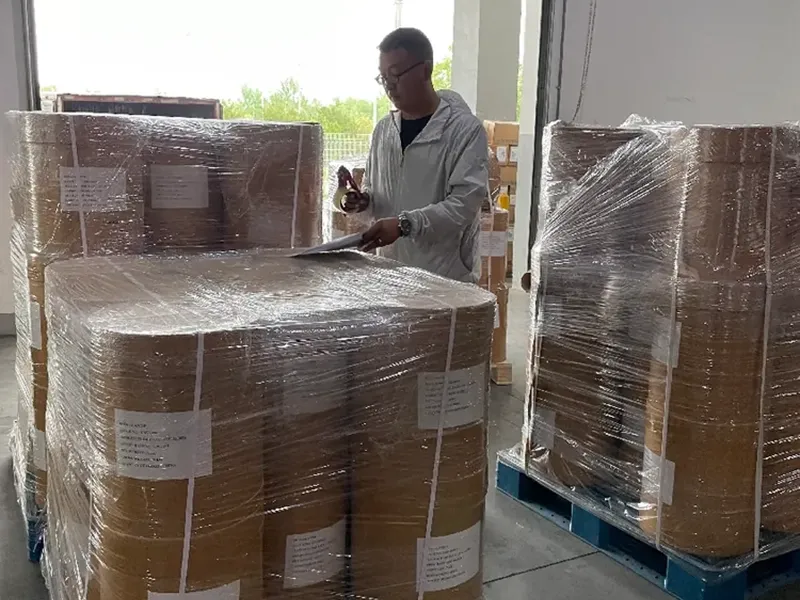
Pre-shipment inspection
Marking, packaging and batch labelling checked at the loading dock before goods are released.
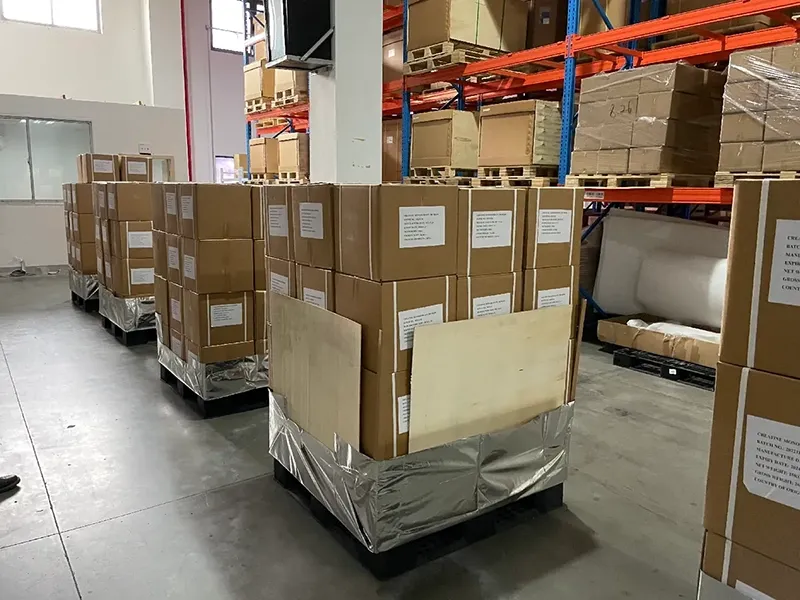
Pre-shipment inspectionExport consolidation
Palletised goods with moisture-barrier packing, strapped and staged for container loading.
Six Reasons Clients Consolidate With Us
Professional Team
Procurement specialists with years in nutritional ingredients and international trade — able to read a specification, question a COA and judge a supplier’s real capacity.
Global Resource Network
Supplier and logistics partners across the world’s main trading regions, so source options are not limited by where your company happens to be.
Standardised Process
The chain is configured to your business model — commodity replenishment, project sourcing or OEM supply — rather than forced into a fixed template.
Tailored Solutions
The chain is configured to your business model — commodity replenishment, project sourcing or OEM supply — rather than forced into a fixed template.
Full-Range Risk Control
Compliance exposure, payment security and logistics delay are managed as one risk profile, not as three disconnected problems.
Transparent Communication
Order progress and logistics status are reported as they happen, so a problem reaches you as information rather than as a surprise.
Client Interests Come First
We handle returns or refunds for products with quality issues (when return or exchange is not feasible).
Risk Reversal
We urge and coordinate suppliers (procurement suppliers, logistics suppliers) to bear corresponding responsibility.
Collaborative Platform
Order, logistics and inventory status are shared across the upstream and downstream nodes of the chain, removing the information lag that produces expediting, air freight and lost sales.
Frequently Asked Questions
Common questions on audit reports, audit timelines, quality issue handling and annual re-audits, plus the full 21 knockout red lines.
Audits & After-Sales
The report follows a dual-track format—the Factory version includes itemized scoring of all 37 audit criteria, non-conformance details, and corrective action recommendations; the Client version is a conclusion report with an overall rating, key risk alerts, and a pass/fail determination.
The on-site execution phase typically takes 1–2 business days (depending on factory size). Including preparation and report generation, the full cycle is approximately 5–7 business days.
The main ones are false labeling, unauthorized additive use, substandard raw materials, lack of testing capability, undisclosed subcontracting, failed environmental assessment, and major quality incidents.
① Immediately respond to client complaints ② Retrieve three-party samples (client problem sample + AccoBio retention sample + factory retention sample) for comparative testing ③ Issue a multi-dimensional investigation report using 5W2H / 5M·8D analysis ④ Factory bears the loss; if the factory fails to cooperate, AccoBio advances compensation.
Each batch’s retention samples are stored for the prescribed period, ensuring that three-way comparison can be conducted whenever an issue arises.
Annual re-audits are conducted every 12 months for projects exceeding USD 500,000 in annual procurement volume. Suppliers with a history of major quality incidents are re-audited within 6 months.
The 21 Knockout Red Lines
The report follows a dual-track format—the Factory version includes itemized scoring of all 37 audit criteria, non-conformance details, and corrective action recommendations; the Client version is a conclusion report with an overall rating, key risk alerts, and a pass/fail determination.
- Forging, altering, or using forged or altered documents in production and business activities, including but not limited to production / operation licences, product registration certificates, filing certificates, inspection and quarantine certificates, certificates of origin, and purchase vouchers.
- Falsely labelling the name of the food, specification, net content, ingredients or ingredient list, standard code, storage conditions, or other information.
- Falsely labelling company name, product registration number, production licence number, processing technology, place of origin, production address, contact information, or other information.
- Falsely labelling production date or shelf life.
- Falsely labelling marks such as pollution-free food, organic food, or green food.
- Providing false food safety self-inspection reports or corrective action reports.
- Food storage services providing false information on their name, address, legal representative or person in charge, and on the owner and contact information of the stored food. (Applies to trader assessment veto)
- Concealing the truth or making false records in product R&D, incoming goods inspection, ex-factory inspection, storage and transportation, handling of non-conforming food, or handling of food safety incidents.
- Using inferior ingredients to substitute for specified ones in the formula.
- Using non-compliant additives or processing aids, or illegally using industrial-grade additives or processing aids.
- Raw materials used by the supplier contain toxic or harmful substances, or toxic substances are found in the production site or product warehouse during on-site assessment. (Applies to trader assessment veto)
- Using chemical reagents or other substances that directly or indirectly affect product quality.
- Raw and auxiliary materials used do not meet the corresponding quality standards, such as national, industry, or enterprise standards.
- Using non-food raw materials, food materials beyond shelf life, or recovered food as raw materials to produce food.
- Lacking the capability to test all quality indicators (including food safety indicators) specified in the quality standard for each batch, without commissioning third-party testing when such capability is absent.
- Process conditions do not comply with requirements, or key control point monitoring or other quality control measures cannot be implemented, failing to guarantee product quality.
- Contract manufacturing (OEM) exists without prior filing and without assessment.
- The on-site assessment is terminated due to the supplier’s non-cooperation or other reasons.
- Failing to pass the environmental impact assessment (EIA).
- The supplier experiences batch quality incidents or has significant potential risks.
- The supplier experiences two major quality incidents within one year, fails national random inspection, or is publicly exposed in quality or credibility incidents within the industry.